
Math Circle 8: Incarnation and Science (Part 2)
On the Universe and Time

On the Universe and Time
IN THIS SECTION James Nickel proposes that the Christian doctrine of the Incarnation broke ancient Greek cyclical views of time (eternal repetition) by affirming linear time with a true beginning and end, rooted in the Triune God as Creator. This gave history purpose, sanctified the physical world, and laid the foundation for modern science’s confidence in a rational, lawful universe.
EN: You argue that science never really took off in other great civilizations because of their underlying beliefs about the universe. Why do you think a Christian view of creation—especially a linear beginning—made such a decisive difference?”
James D. Nickel: It was the historian/theologian Thomas F. Torrance (1913-2007), in Space, Time & Incarnation (1969), who said: “… with Incarnation in its relation to Creation in respect of the questions of space and time, let us recall the principal conceptions of space and time that have arisen in the history of thought which theology has had to use and adapt for its own specific purpose, remembering also that it was largely due to Christianity that we owe the important place given to time in the development of Western thought” (p. 56).
In the subsequent pages, Torrance does a thorough analysis into the notions of space and time, beginning with the receptacle view of space and the circular view of time held by the ancient Greeks, to corrections of these notions by patristic theologians, to the absolute view of space and time by Newton and finally to the relational view of space and time by Einstein, a technical discussion beyond the scope of this essay. You can read it for yourself since a digital version of the book is available from many online sources.
Regarding time, the Greek philosopher Aristotle, Physics (Book IV, 223b), said: “… human affairs move in a circle, coming to be and passing away. This is because all these matters are judged by time, and begin and end as if forming a circle. Time itself seems to be a kind of a circle … because it is measured by cyclic motion.”
To him, history was trapped in an eternity of time cycles, i.e., all things returning to repeat every 36,000 years, i.e., the Great Year. This view mirrored every ancient culture except the Hebrew one, a culture grounded in Genesis 1 that states that all things, history and the physical world, had a beginning.
Since history circles round like a treadmill, the cosmos was necessarily eternal, no beginning, no ending. Engulfed in pantheistic overtones (The Metaphysics (1074b, “the divinity encompasses the entire of Nature”), nature had an emanationist [the belief that all things are “particles” of deity’s “substance”] contact with an impersonal Prime Mover, the one who pushed every object of the heavenly realm in circular orbits.
By the time of Jesus, the ship of Greek science had no wind in its sails. Having reached a plateau with Archimedes (d. 212 BC), a sense of complacency prevailed. According to Pierre Duhem (1861‑1916), French science historian, the failure of Greek science was because of the influence of such theological doctrines as the divinity of the heavens and the cyclical view of time (Le Systéme du monde: Histoire Des Doctrines Cosmologiques (1913-1959), 1:65‑85. See also Paul Tannery, La géométrie grecque. Paris: Gauthier-Villars, 1887).
Like the ancient civilizations before them, their view of history trapped them in a treadmill of endless repetition. In The Road of Science and the Ways to God (1978) science historian Stanley L. Jaki (1924-2009) states: “the problem of the failure of ancient Greek science is largely the failure of the Greeks of old to go resolutely one step beyond the prime heavens to a prime mover absolutely superior to it” (p. 320). He continues: “Needless to say, a world not governed by its divine pilot is a largely irrational world which discourages natural theology and science by the same logic” (p. 340).
In A Mind’s Matter: An Intellectual Biography (2002), Jaki states: “… when I had studied scholastic philosophy I heard no reference to Aristotle’s infatuation with the idea of eternal returns. Of course, he meant that things return only in a generic way. Peripatetics would return as a school, but not as individuals, and so with the Platonists. But other Greek sages held that each and every one would return individually. This could only generate fatalism …” (p. 54). How does an individual view ultimate purpose in this cyclicalism? In the unstoppable sea of recurring history, the individual is a mere bubble, bouncing up and down upon the flow of events, one after another, in an inescapably determined sequence.
A cultural mindset engulfed with the idea of universal cyclic recurrences (1) leads to the weakening of a concept of time which gives to each human action a unique character and decisive meaning, (2) generates pessimism by the obscuring individual achievement in the shadow of inevitable decay, and (3) invites complacently by setting a low ceiling on attainable goals.
Greek mathematics and science stagnated because the big picture ponderings, i.e., the nature of the universe and time, that undergirded these disciplines were not biblical.
In a world governed by the perspective given by Genesis 1, John 1:1-5, and Revelation 21-22, the time we experience had a beginning and it will end in consummated glory, a wonder far beyond our present perception. Time, therefore, is an ethical issue, requiring everyone to redeem the portion given (Ephesians 5:15-21) by seeking the favor of the Lord to confirm, to establish, to give permanence, to the work of one’s hands (Psalm 90).
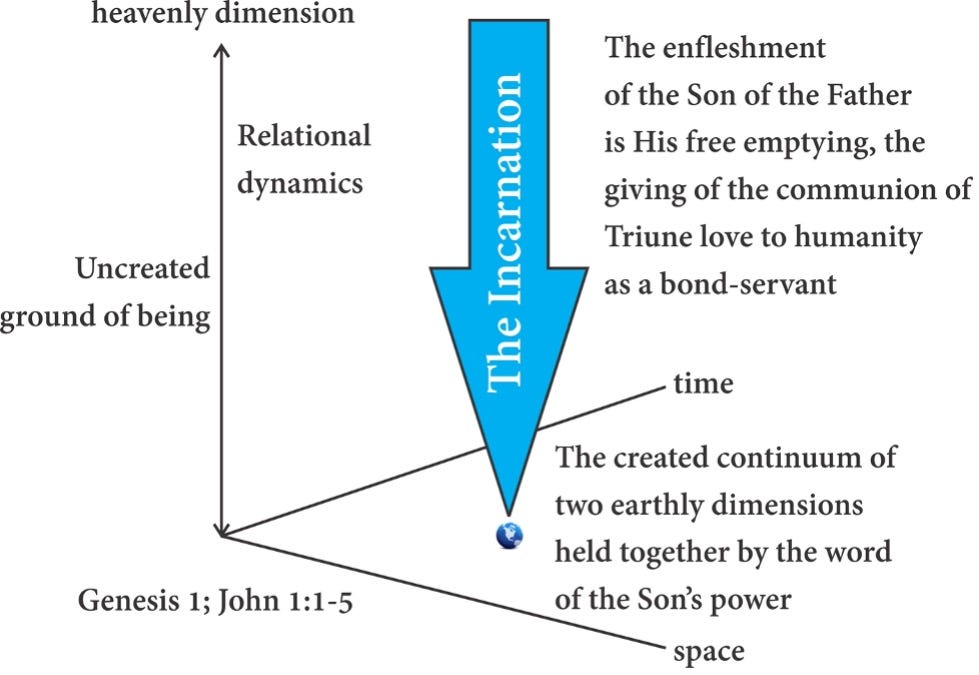
The wonder of the time we experience is that the Triune God acts in it, the supreme act being the giving of the Son by the Father through the Spirit, i.e., the incarnation (Luke 1:26-38; John 1:6-18), the enfleshment of God, as the means of exegeting true knowledge the Creator through audible words and visible actions. … became flesh and tabernacled in us, in the matter of human activity, an Immanuel “God with us” reaffirmation of the goodness of creation. According to Thomas F. Torrance, in Divine and Contingent Order (1998): “The incarnate Son of God’s submission to creaturely limits, conditions, and objectivities, carried with it an obligation to respect the empirical world in an hitherto undreamed of measure” (p. 33). He continues: “The Incarnation had the effect of sanctifying the physical universe for God, thus requiring for it a new respect altogether” (p. 67).
It is this Triune God, not Aristotle’s Prime Mover or Plato’s demiurge, that created and sustains the universe of space and time. Because John used the Greek word Logos as the identifier of the incarnate Son, the Logos who has always been face-to-face with the Father and who became flesh at a specific moment of space-time history, there is, as we previously noted, a rationality, a deep wisdom, in every facet of the world of space and time. The Triune God endows creation with lawfulness and purpose. There is no place to snare this One in the Many, the sui generis onto-relational being revealed by the Incarnate Son, nor the acts of the Father through the Son by the Spirit, in the trap of endless cycles of blind repetitions.
Every science historian needs to rethink, borrowing a book title by Stanley L. Jaki, the origin and science and the science of its origin. If they do this, they will discover that the break from the treadmill of cyclical returns started in the revelation of the Apostle John in his description of the Incarnation of the Son of the Father. Recognizing this break, or removing the blinders from their historical eyes, will help them grasp the issue at hand why we can trace the birth of operational science back to the specificity of the Incarnation, a specificity of “I believe” endorsed in the cultural matrix of Europe during the Middle Ages.
In summary, we listen to Thomas F. Torrance who wrote these words in The Trinitarian Faith: The Evangelical Theology of the Ancient Catholic Church ([1991, 1997] 2016): “… the Christian Faith is concerned with God as he has named himself in Jesus Christ, and incarnated in him his own Word, so that in Christ we know God as he is in his own inner being, as Father, Son and Holy Spirit. Jesus Christ is the arche (ἀρχή), the Origin or Principle, of all our knowledge of God, and of what he has done and continues to do in the universe, so that it is in terms of the relation of Jesus the incarnate Son to the Father, that we have to work out a Christian understanding of the creation. It is the Fatherhood of God, revealed in the Son, that determines how we are to understand God as Almighty Creator, and not the other way round. It was through thinking out the inner relation of the incarnation to the creation that early Christian theology so transformed the foundations of Greek philosophy, science and culture, that it laid the original basis on which the great enterprise of empirico-theoretical science now rests” (p. 7).