
Math Circle 9, Part Two: Clocks as a Reflection of a Worldview
Further illumination on the Middle Ages

One of the great pleasures of interviewing James Nickel is that every answer seems to open another door. James keeps showing that ideas do not emerge in isolation. You begin by talking about clocks and before long you're discussing medieval Christianity, the Scientific Revolution, smartphones, and the Apostle Paul. Along the way, you discover that these subjects are not isolated after all. They are all part of the same story.
Whether you agree with all of his conclusions or not, one thing is certain: James Nickel has a remarkable ability to connect dots that most of us never knew existed. As Sherlock Holmes once observed, "It has long been an axiom of mine that the little things are infinitely the most important." In this interview, a medieval clock becomes one of those "little things" that opens a window onto a much larger view of civilization.
EN: You suggest that the first mechanical clocks were motivated by something deeper than commercial convenience—they were attempts to mirror the orderly movement of God’s creation. How did this vision of the universe as an orderly, intelligible cosmos inspire technological creativity, and do you think modern science has retained or lost that sense of wonder?
James D. Nickel: From his study of the history of technology, English science historian James Burke (1936-) concludes: “The mechanical clock is one of the most fundamental inventions in the history of technology” (Connections, 1978, p. 128).
It was ca. 1280 that the verge and foliat, one of the most ingenious inventions ever constructed, came into existence. (See details in my essay.) Regarding this invention and others, the late Donald S. L. Cardwell, professor of the history of science and technology at the University of Manchester Institute of Science and Technology observed:
“If we seek the reasons for this remarkable emancipation of the human spirit we shall find it difficult to avoid the conclusion that the basic cause must have been the universal religion of Europe. Christianity laid positive duties on men while at the same time rejecting the enervating fatalism of so many ancient and Eastern religions. It provided the right spiritual armour for a man confronting nature in the raw. There is one sovereign Deity who is the ultimate protector and saviour. One does not need to—indeed one must not—appeal to a host of minor deities, godlings, spirits, ghosts. Of course the varieties of Christian religious experience are very wide and the number of philosophies which, in their time, have been reconciled with Christianity considerable. We cannot therefore argue that Christianity was always and everywhere uniform in effect. But we do suggest that a central component of its doctrines had the effect we have just described and thus emboldened medieval man to develop his technics and later, in fact, to establish his science” (Turning Points in Western Technology (1991), p. 7. See also his extraordinary 1995 book Wheels, Clocks, and Rockets: A History of Technology).
In Science and Creation ([1974, 1986] 2016), the late Stanley L. Jaki wrote a chapter entitled “The Leaven of Confidence” (pp. 163-191). He showed that early Christian theology, while appreciating some positive aspects of ancient paganism, also swung a crushing counter-punch. Its liberating doctrine of an orderly, intelligible cosmos engendered the leaven of boldness when interacting with the world of time and space.
It was this leavening of the Faith that produced, in time, the creative attitudes/inventions of the Middle Ages. As I stated in my answer to Question 1, the many labor-saving devices thus invented set humans free to pursue other creative activities, thus generating a feedback loop, a process where the output of one age circles back to become an input for another, influencing future results that create another cycle of cause and effect. The feedback loop of the Middle Ages bore the fruit of the Scientific Revolution, which bore the fruit of the Industrial Revolution, which bore the fruit of the digital Information Age of our time.
Do I think modern science has retained or lost a sense of wonder? It has lost wonder in its failure to see these feedback loop connections. When a scientist or scientific historian sees these connections, wonder is the crowning result. The work of historian James Burke and physicist Richard Feynman (1918-1988) exemplifies the wonder of seeing connections.
Who Serves Whom?
EN: You point out that most people today have no idea that modern science has these medieval Christian roots. If that connection were widely understood again, what do you think would change—either in science itself or in how we think about faith? Near the end of the essay you write that the clock can either be a tool for ‘redeeming the time’ or a remorseless master that enslaves us. (I think here of the white rabbit in Alice in Wonderland.) In an age of smartphones, digital calendars, and constant notifications, do you think we have become servants of our clocks rather than masters of them? What would it mean today to redeem time rather than merely measure it?
JDN: It goes without question that it would behoove all scientists to learn about the medieval roots of their discipline. They would then save themselves from the intellectual and moral futility of absolutizing either rational thinking or empirical investigation, i.e., either a priori or a posteriori approaches. A robust biblical theology grounded in the Logos (reason) who is the incarnate Son of the Father who holds all things together would place the a priori and a posteriori in their proper contexts, as servants and not masters. Science and mathematics, its peripheral adjunct, would therefore engender a radical humility with a vision of implementing wholeness in creation, humanity, and culture as its goal. The disciplines of science and mathematics require, therefore, an evangelical impetus to get them moving in the right direction.
The 21st-century engagement with technology such as smartphones, digital calendars, and constant notifications requires redemptive thinking. Too often, as you note, they become our masters. The “tick-tock” becomes an overlord.
The apostle Paul addresses this issue in Ephesians 5. In verse 16, he wrote, “Therefore be careful how you walk, not as unwise men but as wise, making the most of your time, because the days are evil.” These two commands, “be careful how you walk,” and “making the most of your time” are sandwiched in a theological context, and we must understand that context to grasp the directives of Paul. We quote from Ephesians 5, starting from verse 1:
“Therefore be imitators of God, as beloved children; and walk in love, just as Christ also loved you and gave Himself up for us, an offering and a sacrifice to God as a fragrant aroma. But immorality or any impurity or greed must not even be named among you, as is proper among saints; and there must be no filthiness and silly talk, or coarse jesting, which are not fitting, but rather giving of thanks. For this you know with certainty, that no immoral or impure person or covetous man, who is an idolater, has an inheritance in the kingdom of Christ and God. Let no one deceive you with empty words, for because of these things the wrath of God comes upon the sons of disobedience. Therefore do not be partakers with them; for you were formerly darkness, but now you are Light in the Lord; walk as children of Light (for the fruit of the Light consists in all goodness and righteousness and truth), trying to learn what is pleasing to the Lord. Do not participate in the unfruitful deeds of darkness, but instead even expose them; for it is disgraceful even to speak of the things which are done by them in secret. But all things become visible when they are exposed by the light, for everything that becomes visible is light. For this reason it says, ‘Awake, sleeper, and arise from the dead, and Christ will shine on you.’
[Now to Paul’s conclusion]: Therefore be careful how you walk [The phrase is one word in the Greek—exagorazōmenoi: to redeem, to set free, to buy off; to secure for one’s self or one’s own use; to rescue from loss or misapplication.], not as unwise men but as wise, making the most of your time, because the days are evil.
So then do not be foolish, but understand what the will of the Lord is. And do not get drunk with wine, for that is dissipation, but be filled with the Spirit, speaking to one another in psalms and hymns and spiritual songs, singing and making melody with your heart to the Lord; always giving thanks for all things in the name of our Lord Jesus Christ to God, even the Father; and be subject to one another in the fear of Christ” (Ephesians 5:1-21).
We misread Paul because we think our English translations that use “time” in verse 16 is referent to the tick-tock of a modern clock. He used the Greek word kairos which means “opportunity” or “season.” The other word used in the New Testament for time is chronos. It has a sense of simple chronological time, while kairos has a focus on a special or distinctive period. Chronos is the march of “tick-tock,” while kairos requires us to understand the world it which we live and our place within it. We ask ourselves:
“What season is it for the course of my life?”
“What season is it for the culture surrounding me?”
“How, then, do I think and act accordingly?”
In ancient history, the sons of Issachar modeled how to redeem a season. They studied the season, the kairos, in a way that generated knowledge, a thoroughly going knowledge that led to action. In 1 Chronicles 12:32, we read:
“Of the sons of Issachar [Hebrew meaning—”he will bring a reward”], men who understood [Hebrew: yada bı̂ynâh, Greek Septuagint: ginoskontes sunesin] the time [Hebrew: ayath, Greek Septuagint: eis kairos], with knowledge [Greek Septuagint: ginoskontes] of what Israel should do …”
We can wisely make use of the gifts of modern technology only in the theological context that Paul articulates. Each one of us is required to seek the wisdom of the Holy Spirit in making the most of the present season, making sense of the interpenetration of kairos with chronos, of season with “tick-tock.”
Extra: AFTERTHOUGHT QUESTION
EN: You are a mathematician by training, yet your essays often weave together mathematics, history, theology, engineering, and philosophy. What first convinced you that ideas are best understood not in isolation but as part of a broader, multi-dimensional view of civilization that transcends a single discipline?
JDN: When I was teaching at a small Christian school in Booleroo Centre, South Australia, in the 1980s, its size required me not only to teach mathematics but also history, science, economics, writing, Greek. I learned from this experience that one cannot teach a discipline in isolation, i.e., there is a history of mathematics, there is a scientific component to mathematics, mathematics is a language, and, yes, math symbols use Greek letters! My students often repeated these observations in math class:
“Are we learning history or mathematics?”
“What you are teaching is science. We have a science class in our math class!”
In the spring of 1979, while attending a week-long world view course for teachers in Kailua-Kona, Hawaii, I questioned the instructor and my consequent lifelong mentor Dr. Glenn R. Martin (1935-2004) of Indiana Wesleyan University: “How do I to start to understand and teach mathematics re-interpretively?” His answer: “Master its history and how it developed in different cultures.”
Unfortunately, I knew little of its history or, for that matter, its connections to science, from my university training. In classes, I heard the names—Euclid, Archimedes, Diophantus, Descartes, Stevin, Viète, Fermat, Cardano, Euler, Bernoulli, Lagrange, Gauss, Riemann, Cauchy, Dedekind, Weierstrass, etc.—but nothing of who these men were and how they fit into their respective eras. I engaged in that type of study and discovered that mathematicians are people, too! They had their quirks and talents; they were flesh and blood like the rest of us.
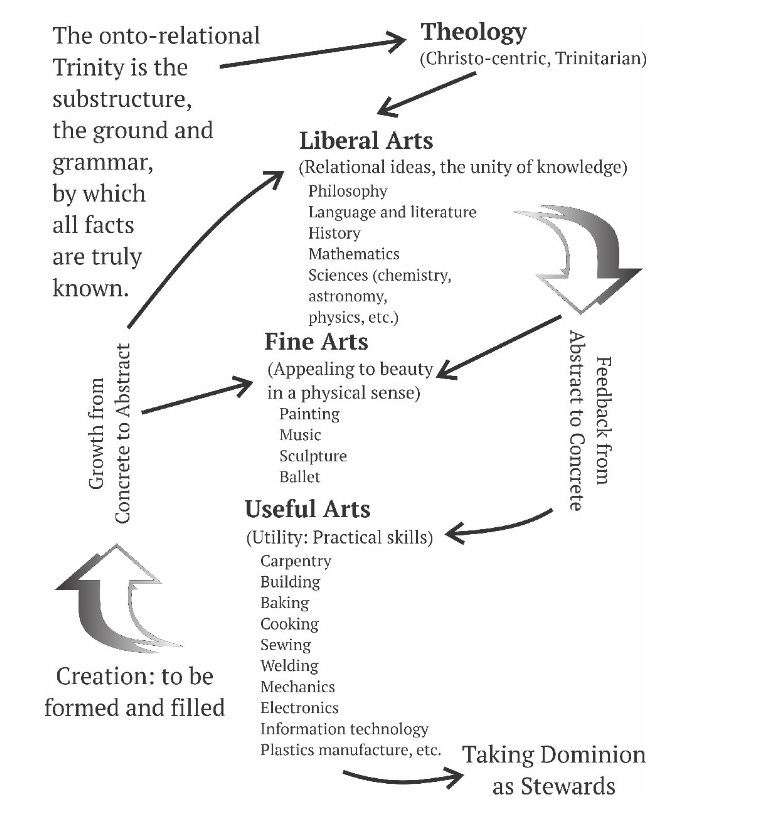
Extension/re-interpretation of a graphic used by Ventura College [California] Chemistry instructor Tom Hughes (1919-2005) in his textbook Chemistry Connections ([1975],1983), p. 10.
One will not learn, as you say, of a broader, multi-dimensional view of civilization that transcends a single discipline in four years of university or, for that matter, postgraduate school. Any university professor who can bring that understanding into a classroom is an outlier. Learning in this context is lifelong, a fascinating exercise that unfolds interpenetrating multiplicities of wonder. That makes learning and teaching any discipline a joyfully rewarding exercise for both teacher and student.
For more of James D. Nickel’s Math Circles visit biblicalchristianworldview.net
If you missed it, read Part One of Math Circle 9 on Clocks: Heritage of the Christian Faith.